
Tailgating is part of football culture in College Station, Texas, but game day does not suspend state alcohol laws. If you drink before or after a game, the legal risk depends on where the alcohol is located, whether a vehicle is involved, your age, your conduct, and what officers can prove.
Texas law can lead to allegations involving DWI, public intoxication, an open container in the passenger area of a vehicle on a public highway, minor in possession or consumption, driving by a minor with a detectable amount of alcohol, or furnishing alcohol to a minor. Campus, venue, parking-lot, and event rules may also apply even when a particular Texas criminal statute does not.
The Greening Law Group helps people in College Station evaluate alcohol-related allegations, preserve evidence, and understand the court and driver-license processes before making major decisions.






Tailgating Itself Is Not a Texas Crime 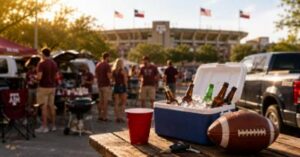
Texas does not have a criminal offense called “tailgating.” A lawful tailgate can include food, music, gatherings, and alcohol when the property owner or event rules allow it and everyone follows applicable law.
Several separate Texas laws can apply once alcohol is present. Game-day issues may involve:
- Open containers in certain parts of a vehicle on a public highway
• Public intoxication
• DWI
• Minor in possession or consumption of alcohol
• Purchase or attempted purchase of alcohol by a minor
• Misrepresentation of age by a minor
• Driving by a minor with any detectable amount of alcohol
• Furnishing alcohol to a minor
Texas A&M University rules can also regulate alcohol on university premises and at university-sponsored events. A location that permits tailgating may still have conditions governing where alcohol may be possessed or consumed.
The key point is that drinking at an authorized tailgate is not automatically a criminal offense. The legal analysis changes when alcohol is connected to a vehicle, a public place, a person under 21, dangerous conduct, or driving.
When you hire our team, you’re not just getting experience. You’re getting people who care. We work hard on every case because we know it matters to you. And we’ll treat your case like it’s the only one that matters. That’s how we’ve stood out from the rest.
A Legal Team You Can Count On
Open Containers Around Tailgates and Vehicles
Texas Penal Code Section 49.031 makes it an offense to knowingly possess an open container in the passenger area of a motor vehicle that is located on a public highway. The law applies whether the vehicle is moving, stopped, or parked.
An “open container” can include a bottle, can, cup, or other receptacle that contains any amount of alcohol and:
- Is open
• Has been opened
• Has a broken seal
• Has had some of its contents removed
The “passenger area” generally means the area designed for the driver and passengers. It does not include a locked glove compartment or similar locked storage container, the trunk, or the area behind the last upright seat in a vehicle without a trunk.
The statute also defines “public highway” broadly. It can include the full width of a public road, street, highway, interstate, or other publicly maintained way, together with areas immediately adjacent to its boundary lines.
A private event parking lot does not automatically fall within this specific open-container statute merely because a tailgate is taking place there. The location still matters, and campus or property rules may be broader. An open beer in a cupholder of a truck parked along a public roadway presents a different legal issue from a cooler outside a vehicle in an authorized private tailgating area.
An open-container violation under Section 49.031 is a Class C misdemeanor.
Read more about Texas open-container law:
https://www.craiggreeninglaw.com/blog/understanding-texas-open-container-law/
Highly Recommend Craig Greening. Craig is personable and cultivated, you will feel confident next to him! Worth every penny, he is a superlative attorney. Don't rush the process, getting the deal you want takes time! Mike D. I just want to say how amazing your firm is. You guys know exactly what you are doing and have helped me out tremendously. Thank you so much for everything you have done and continue to do. David B. Maddie was polite, professional and very helpful. The group was expedient in responding to requests and I feel I'm in good hands. Thanks guys! Gently E.
Public Intoxication Can Happen Without Driving
You do not have to drive to face an alcohol-related charge. Under Texas Penal Code Section 49.02, public intoxication can be charged when a person appears in a public place while intoxicated to the degree that the person may endanger themselves or another person.
For a person who is at least 21, public intoxication is generally a Class C misdemeanor. A person younger than 21 is punished under the provisions that apply to certain alcohol-related offenses by minors.
Texas defines a public place broadly. Depending on access and location, a public street, sidewalk, walkway, common area, parking area, or event space may qualify.
The state must prove more than the fact that you consumed alcohol. The public intoxication statute requires intoxication to the degree that you may endanger yourself or another person.
Evidence may include:
- Body-camera footage
• Witness statements
• Your conduct and statements
• Balance and coordination
• Speech
• Location
• Nearby traffic or crowds
• Attempts to enter a roadway
• Other facts connected to possible danger
Being loud, emotional, tired, or unsteady does not by itself establish every element of public intoxication. Heat, fatigue, injuries, medical conditions, footwear, uneven ground, and crowd movement can affect how a person appears. Video and witness accounts may help show details that are missing from a written police report.
Learn more about public intoxication defense in College Station:
https://www.craiggreeninglaw.com/college-station-alcohol-offense-lawyer/public-intoxication/
When Tailgating Turns Into a DWI Investigation
A game-day alcohol investigation can become more serious when someone drives after drinking. Texas Penal Code Section 49.04 applies when a person is intoxicated while operating a motor vehicle in a public place.
Texas defines intoxication in two main ways. A person may be considered intoxicated if:
- The person does not have the normal use of mental or physical faculties because of alcohol, drugs, another substance, or a combination of substances
• The person has an alcohol concentration of 0.08 or more
A DWI allegation does not require a breath or blood result of 0.08 or higher if the state claims that alcohol or another substance caused a loss of normal mental or physical faculties.
A first DWI is generally a Class B misdemeanor. If the driver had an open container of alcohol in the driver’s immediate possession, the offense remains a Class B misdemeanor but carries a higher minimum confinement term. If testing shows an alcohol concentration of 0.15 or more at the time the specimen was analyzed, the offense can be a Class A misdemeanor.
Game-day traffic can complicate roadside observations. Heavy congestion, pedestrians, detours, police-directed traffic, unfamiliar lane patterns, sudden stops, and vehicles leaving crowded parking areas may affect what an officer sees.
Evidence that may matter includes:
- Dash-camera and body-camera video
• Road and traffic conditions
• Parking records
• Witness accounts
• Field sobriety test video
• Breath or blood testing records
• The timing of alcohol consumption
• Statements made during the stop
• The location where the vehicle was allegedly operated
A DWI arrest is not a conviction. The state must prove every required element beyond a reasonable doubt.
Learn more about College Station DWI defense:
https://www.craiggreeninglaw.com/college-station-dwi-lawyer/
Underage Tailgating Can Lead to Several Separate Alcohol Charges
College Station tailgates often include students and younger guests. Texas Alcoholic Beverage Code Chapter 106 generally defines a “minor” as a person under 21 for these alcohol offenses.
Depending on the facts, a person under 21 may face allegations involving:
- Purchase of alcohol
• Attempted purchase of alcohol
• Consumption of alcohol
• Possession of alcohol
• Misrepresentation of age
• Driving with a detectable amount of alcohol
Many of these offenses are generally Class C misdemeanors for a first or early offense, though repeat allegations can carry different consequences.
Texas law contains limited exceptions. For example, possession may be lawful in the visible presence of the minor’s adult parent, guardian, spouse, or certain court-appointed custodians. Consumption has an affirmative defense when it occurs in the visible presence of the minor’s adult parent, guardian, or spouse. Other statutory exceptions can apply in limited circumstances.
Those exceptions do not erase campus, event, venue, or property rules. A person can comply with one state-law exception and still violate a separate university or event policy.
Read more about alcohol-related student offenses:
https://www.craiggreeninglaw.com/college-station-student-defense-lawyer/alcohol-related-offenses/
Read more about minor in possession allegations:
https://www.craiggreeninglaw.com/college-station-minor-in-possession-lawyer/
Texas Has a Separate Zero-Tolerance Driving Rule for Minors
Texas Alcoholic Beverage Code Section 106.041 creates a separate rule for drivers under 21. A minor can be charged for operating a motor vehicle in a public place while having any detectable amount of alcohol in the minor’s system.
That standard is different from the adult DWI definition. A person under 21 does not need to have an alcohol concentration of 0.08 or higher to face an allegation under Section 106.041.
A minor may also face a DWI charge under Texas Penal Code Section 49.04 if the state claims the person was legally intoxicated while operating a motor vehicle in a public place.
That distinction can matter after a game-day stop because the charge, evidence, possible penalties, and driver-license consequences may differ.
Adults Can Face Charges for Furnishing Alcohol to a Minor
Tailgating hosts should pay close attention to who receives alcohol. Texas Alcoholic Beverage Code Section 106.06 generally makes it an offense to purchase alcohol for or give alcohol to a minor unless a statutory exception applies.
One exception permits an adult parent, guardian, spouse, or an adult who has court-ordered custody of the minor to purchase or provide alcohol when that adult is visibly present while the minor possesses or consumes it. Another limited statutory exception applies in certain authorized situations.
Outside an applicable exception, furnishing alcohol to a minor is generally a Class A misdemeanor.
The charge can become a state jail felony if the state proves that the person purchased or gave alcohol to a minor and, as a result of consuming that alcohol, the minor caused another person to suffer serious bodily injury or death.
The age of the recipient, the relationship between the people involved, who provided the alcohol, and what happened afterward can all affect the legal analysis.
What Evidence Can Matter After a Tailgating Arrest or Citation
Game-day alcohol cases often depend on details that can disappear quickly. Parking areas clear out, temporary signs come down, witnesses leave town, and video may be overwritten.
A defense review may include:
- Body-camera footage
• Dash-camera footage
• Photographs or video from the tailgate
• Parking receipts
• Parking-lot entry records
• Rideshare receipts
• Text messages about transportation plans
• Witness names and contact information
• The location of coolers, cups, and vehicles
• Breath or blood testing records
• Field sobriety test video
• Event or parking-lot rules
• Maps or photographs showing whether a vehicle was on a public roadway
• Medical records that may explain balance, speech, or appearance
Consider a person who moves a vehicle a short distance after drinking earlier in the day. Whether the facts support a DWI allegation can depend on where the vehicle was located, whether the location was a public place, evidence of operation, signs of intoxication, video, statements, and test results.
Small factual differences can change the legal analysis.
What to Do After an Alcohol-Related Game-Day Charge
A citation or arrest is not a conviction. You still have the right to review the evidence and challenge whether the state can prove the charge.
After a game-day alcohol arrest or citation, consider these steps:
- Keep every citation, bond paper, property receipt, and release document.
• Write down what happened while the details are still fresh.
• Save photographs, videos, parking records, receipts, rideshare records, and text messages.
• Identify witnesses and preserve their contact information.
• Avoid posting details about the incident on social media.
• Do not delete messages, photographs, or video that could become evidence.
• Follow all bond, court, university, and driver-license requirements.
• Ask a lawyer promptly about any deadline connected to your driver’s license or court case.
• Do not assume that paying a citation is the same as making the matter disappear.
A lawyer can compare the police report with video, testing records, witness accounts, and the statutory elements of the charge.
Frequently Asked Questions About Texas Tailgating Alcohol Laws
Can You Drink Alcohol at a Tailgate in College Station?
Possibly. Texas does not ban tailgating as a category, but the property owner, university, venue, parking operator, and event organizer may impose rules on alcohol. State criminal laws still apply to DWI, public intoxication, minors, furnishing alcohol to minors, and open containers in vehicles on public highways.
Can You Have an Open Beer in a Parked Vehicle?
The answer depends on where the vehicle is located and where the alcohol is kept. Texas Penal Code Section 49.031 applies to knowingly possessing an open container in the passenger area of a motor vehicle on a public highway, even when the vehicle is parked.
Does an Open Container Automatically Mean DWI?
No. An open-container allegation and a DWI allegation have different elements. An open container may become relevant to a DWI case, but possession of an open container does not by itself prove that the driver was intoxicated.
Can You Be Charged With Public Intoxication Just for Drinking at a Tailgate?
Drinking alcohol alone does not satisfy every element of public intoxication. Texas law requires proof that the person appeared in a public place while intoxicated to the degree that the person may endanger themselves or another person.
Can a Parent Give Alcohol to a Person Under 21 in Texas?
Texas law contains a limited exception involving an adult parent, guardian, or spouse who is visibly present while the minor possesses or consumes alcohol. The precise exception depends on the offense. University, venue, and event rules may still prohibit the conduct.
Can a Person Under 21 Be Charged After Driving With Less Than 0.08?
Yes. Texas has a separate law that can apply when a person under 21 operates a motor vehicle in a public place with any detectable amount of alcohol in the person’s system. A separate DWI charge may also apply if the facts satisfy Texas Penal Code Section 49.04.
Talk With a College Station Alcohol and DWI Defense Lawyer
A game-day alcohol charge can affect your court obligations, driving privileges, school status, employment, and record. The exact consequences depend on the charge and the facts.
The Greening Law Group represents people facing DWI, public intoxication, minor alcohol, and other alcohol-related allegations in College Station, Texas, and nearby areas. Led by Board Certified criminal law attorney Craig Greening, the firm reviews police conduct, video, testing, witness accounts, location evidence, and the legal elements of the charge.
The firm provides 24/7 legal consultations.
Call the College Station office at (979) 773-7010.
Contact The Greening Law Group:
https://www.craiggreeninglaw.com/contact-us/
This article is for general informational purposes only. It is not legal advice and does not create an attorney-client relationship. Consult an attorney about your specific circumstances.

|
|
|