
When a driver fails a field sobriety test in College Station, Texas, they may face serious legal consequences. A failed test does not guarantee a conviction, but it marks the beginning of a legal journey that involves arrest, potential charges, and possibly a court trial. It’s essential for anyone in this situation to understand the implications of such a failure and the steps that follow.
When you hire our team, you’re not just getting experience. You’re getting people who care. We work hard on every case because we know it matters to you. And we’ll treat your case like it’s the only one that matters. That’s how we’ve stood out from the rest.
A Legal Team You Can Count On
Understanding the Field Sobriety Test Process in College Station 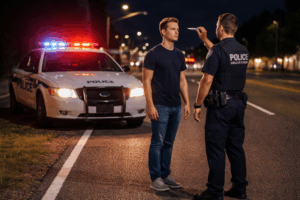
In College Station, law enforcement uses field sobriety tests (FSTs) to determine whether a driver is under the influence of alcohol or drugs. These tests are typically administered after an officer has reasonable suspicion that a driver is impaired. While failing these tests can lead to an arrest, the consequences are not set in stone. It’s important to note that many people fail field sobriety tests for reasons that have nothing to do with alcohol or drug use.
There are three main tests commonly used by law enforcement:
- Horizontal Gaze Nystagmus (HGN) Test: This test checks for involuntary jerking of the eyes as they follow a moving object. The presence of this jerking can suggest impairment, but it can also be affected by medical conditions or nervousness.
- Walk-and-Turn Test: This test measures balance and coordination. A person is asked to walk a straight line, turn on one foot, and return. Poor balance, anxiety, or physical impairments can make this test challenging even for sober individuals.
- One-Leg Stand Test: Here, a driver is asked to lift one leg off the ground and hold it for a set amount of time. It tests balance and coordination, which can be difficult for anyone with mobility issues or even someone feeling nervous.
While these tests are designed to evaluate a person’s physical state, they are not foolproof and can be influenced by a range of factors, such as health conditions or external distractions. The results of these tests, when combined with other observations from the arresting officer, can lead to an arrest for driving while intoxicated (DWI).
What Happens After Failing a Field Sobriety Test?
After a person fails a field sobriety test in College Station, the immediate consequence is often an arrest. The officer may then request the individual to take a breathalyzer test or a blood test to measure their blood alcohol concentration (BAC). Refusing to take these tests is a legal violation in Texas and can lead to serious penalties, including the automatic suspension of your driver’s license.
It’s important to understand that while failing a field sobriety test may lead to arrest, it doesn’t automatically mean the driver will be convicted of DWI. The legal process involves a number of steps, and there are ways to challenge the evidence in court. In many cases, field sobriety test results are just one part of the puzzle, and your defense attorney can work to weaken the prosecution’s case.






The Legal Process After a Field Sobriety Test Failure
Once arrested, the individual will be taken into custody, and a booking process will begin. This process includes collecting personal information and, in some cases, fingerprinting. Afterward, the arrested individual may be asked to take a breathalyzer test or a blood test to measure their BAC.
If the BAC is above the legal limit of 0.08%, the driver may be formally charged with DWI. However, even in these cases, a conviction is not guaranteed. Many factors can affect the outcome of a DWI case, including:
- Test Accuracy: The reliability of field sobriety tests is often questioned, especially when they are not administered according to the correct procedures. Law enforcement officers must follow strict guidelines when conducting these tests, and any deviations from these procedures could undermine the evidence.
- Medical Conditions: Certain medical conditions can affect a person’s ability to pass a field sobriety test. For instance, a person with a neurological disorder or a leg injury may struggle with the physical tasks involved in these tests. In these cases, the results may not be valid indicators of intoxication.
- Environmental Factors: The environment in which the tests are conducted can also impact the results. For example, if the road is uneven, poorly lit, or has distracting elements, it can make it more difficult for the person to perform the test accurately.
- Officer’s Conduct: If the officer did not explain the instructions properly or did not follow the correct procedures, the results of the field sobriety test may be challenged.
Once the charges are filed, the next step is a court appearance. During the court hearing, the judge will review the evidence, including the results of the field sobriety tests, any BAC readings, and the officer’s observations. Your attorney will have the opportunity to challenge the evidence and may seek to have the charges reduced or dismissed.
Highly Recommend Craig Greening. Craig is personable and cultivated, you will feel confident next to him! Worth every penny, he is a superlative attorney. Don't rush the process, getting the deal you want takes time! Mike D. I just want to say how amazing your firm is. You guys know exactly what you are doing and have helped me out tremendously. Thank you so much for everything you have done and continue to do. David B. Maddie was polite, professional and very helpful. The group was expedient in responding to requests and I feel I'm in good hands. Thanks guys! Gently E.
Challenging Field Sobriety Test Results
It’s crucial to understand that field sobriety tests are not always accurate. As mentioned, medical conditions, environmental factors, and improper test administration can all lead to incorrect results. An experienced attorney, such as those at The Greening Law Group, can help investigate these issues and may be able to argue that the tests were not a fair representation of the driver’s actual condition.
In College Station, the most common defense strategies for challenging field sobriety tests include:
- Questioning the officer’s conduct: If the officer didn’t follow proper procedures or failed to give clear instructions, the results may be invalid.
- Highlighting medical conditions or impairments: If the individual has a medical condition that affected their ability to perform the tests, this can be used as a defense.
- Environmental factors: If the tests were conducted in an area that was unsafe or distracting, this can be used to argue that the results should not be trusted.
What Defenses Are Available?
If you’ve been arrested after failing a field sobriety test, it’s essential to speak with a lawyer who can examine the facts of your case. A strong defense strategy can make all the difference. In addition to challenging the results of the field sobriety tests, your attorney may explore other avenues of defense, including:
- Lack of probable cause for the traffic stop: If the officer did not have a valid reason to stop your vehicle in the first place, any evidence gathered during the stop may be inadmissible in court.
- Violation of your rights during the arrest: If your rights were violated during the arrest or testing process, such as if you were not informed of your right to remain silent or to have an attorney present, this may lead to the dismissal of charges.
- Inaccurate BAC readings: Breathalyzer and blood tests are not infallible. Several factors, including improper calibration of the equipment or contamination of the blood sample, can result in inaccurate BAC readings. Your attorney will work to ensure that any such issues are addressed in your defense.
What Happens if You Are Convicted of DWI?
If a conviction for DWI is unavoidable, it’s important to understand the penalties involved. In Texas, a first-time DWI conviction can lead to penalties such as:
- Fines
- License suspension
- Mandatory alcohol education classes
- Possible jail time
However, it’s important to note that the penalties vary depending on the circumstances, including whether there were aggravating factors such as a high BAC, prior convictions, or if there were passengers in the vehicle at the time of the arrest. In some cases, it may be possible to negotiate a plea deal or seek alternative sentencing options, such as probation.
Failing a field sobriety test in College Station is a serious matter, but it doesn’t necessarily result in a conviction. The process involves several legal steps, and there are many opportunities to challenge the evidence presented against you. With the right defense, it may be possible to reduce or dismiss the charges. If you or someone you know is facing DWI charges after failing a field sobriety test, contact The Greening Law Group for experienced legal guidance.
To learn more about this subject click here: Field Sobriety Tests in Texas DWI Cases: Understanding Their Accuracy

|
|
|