
Traffic stops after concerts in Texas often involve heightened enforcement, increased suspicion of impairment, and fast-moving decisions that can lead to citations or criminal charges. Understanding how these stops unfold, what officers are trained to look for, and how evidence is gathered can help drivers make more informed choices in stressful moments. The Greening Law Group works with individuals across College Station and Texas who face DWI investigations and related charges following traffic stops.






The Greening Law Group represents individuals across Texas who find themselves dealing with unexpected traffic stops after concerts, sporting events, and large public gatherings. These situations often unfold quickly, with limited time to react, and the choices made during those first few minutes can shape everything that follows. Concert nights create a unique environment where heavy traffic, late hours, and increased police presence combine, making drivers more likely to be stopped even for minor driving behavior that might otherwise go unnoticed on a normal evening.
Why concert traffic creates increased enforcement activity in Texas 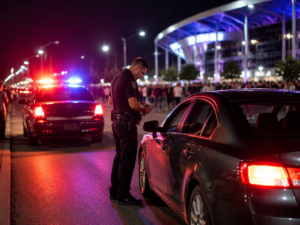
Large concerts in Texas draw thousands of people into concentrated areas, often late at night when fatigue is already setting in for many drivers. Law enforcement agencies anticipate this pattern and position officers along major exits, highways, and surrounding roads to monitor traffic flow and identify unsafe driving behavior. In places like College Station, this can be especially noticeable around major venues, university events, and seasonal festivals where traffic congestion naturally increases. Officers are not randomly stopping vehicles without reason, but the conditions surrounding these events often lead to more observations of minor traffic violations, which then become the basis for a stop.
Driving behavior after leaving a concert can vary widely depending on crowd size, weather, and how long someone has been in transit. Even small mistakes such as delayed lane changes, inconsistent speed, or failure to signal can draw attention in these environments. What might be overlooked during normal daytime driving becomes more visible when officers are specifically watching for signs of impairment or unsafe driving patterns during peak event hours.
What officers are often looking for during post-concert stops
Once a vehicle is stopped, the interaction tends to move quickly from a routine traffic issue into a broader evaluation of the driver. Officers are trained to observe a range of indicators that may suggest impairment, including speech patterns, eye movement, coordination, and even the presence of certain odors inside the vehicle. After concerts, officers may also take into account the time of night, the location of the stop, and whether the driver is leaving a known entertainment venue.
Drivers often do not realize how closely these initial observations are being documented. Even casual conversation during the stop can become part of an officer’s report. Questions about where someone has been or whether alcohol was consumed are commonly asked, and responses may influence whether further testing is requested. While the situation may feel informal, it is treated as the beginning of a structured investigation when impairment is suspected.
When you hire our team, you’re not just getting experience. You’re getting people who care. We work hard on every case because we know it matters to you. And we’ll treat your case like it’s the only one that matters. That’s how we’ve stood out from the rest.
A Legal Team You Can Count On
How a Texas traffic stop can escalate into an investigation
A standard traffic stop in Texas typically begins with a request for license, registration, and insurance. However, in concert-related scenarios, the situation can escalate if the officer believes there are signs of impairment. At that point, the stop may shift from a traffic matter into a criminal investigation.
Field sobriety tests may be introduced at the roadside, often in low-light conditions, uneven pavement, or high-traffic areas. These conditions can affect performance regardless of impairment. Officers may also ask drivers to step out of the vehicle, which can increase stress and make coordination more difficult. If concerns remain, chemical testing such as breath or blood analysis may be requested or required through a legal process.
Understanding your rights during a traffic stop in Texas
Drivers in Texas are required to provide basic identifying information during a traffic stop, but there are limits to what must be shared beyond that. Conversations with law enforcement can feel routine, yet statements made during this time can carry weight later. Many drivers are not aware that they are not obligated to answer questions that go beyond identification, especially those related to alcohol consumption or where they have been earlier in the evening.
Searches of a vehicle generally require consent, probable cause, or a warrant. Despite this, consent is often given during stops without full awareness of the implications. Understanding these boundaries can play a significant role in how a situation develops. More detail on warrant procedures can be found here:
https://www.craiggreeninglaw.com/blog/different-types-of-warrants-in-texas/
Field sobriety testing in real-world conditions
Field sobriety tests are commonly used during suspected impairment investigations, but they are not always conducted in ideal conditions. After a concert, drivers may be tired, dehydrated, or wearing clothing and footwear that affects balance. These factors can influence performance on coordination-based tasks that require concentration and physical stability.
Common tests may include walking in a straight line, standing on one leg, or following an object with the eyes. These tests are interpreted by the officer in real time, which introduces a degree of subjectivity. Environmental factors such as lighting, traffic noise, and uneven surfaces can also affect outcomes. What many drivers do not realize is that performance on these tests is not always a definitive indicator of impairment, yet they are often used as part of the justification for further action.
Highly Recommend Craig Greening. Craig is personable and cultivated, you will feel confident next to him! Worth every penny, he is a superlative attorney. Don't rush the process, getting the deal you want takes time! Mike D. I just want to say how amazing your firm is. You guys know exactly what you are doing and have helped me out tremendously. Thank you so much for everything you have done and continue to do. David B. Maddie was polite, professional and very helpful. The group was expedient in responding to requests and I feel I'm in good hands. Thanks guys! Gently E.
Breath and blood testing after a stop
If an officer believes impairment is likely, chemical testing may be requested. Breath testing devices are commonly used roadside, while blood tests may be conducted later at a medical facility. These tests are often treated as strong evidence, but they are not without issues. Timing, calibration, storage, and procedural handling can all affect reliability.
In some cases, law enforcement may seek a warrant to obtain a blood sample if a driver refuses testing. This process adds another legal layer to the situation and can become a central issue in how a case is evaluated later. More information on testing reliability can be reviewed here:
https://www.craiggreeninglaw.com/blog/are-dwi-blood-tests-reliable
What happens to passengers during a stop
Passengers in a vehicle are generally not the focus of impairment investigations, but they may still be questioned depending on the circumstances. Their statements can sometimes be used to support or challenge an officer’s observations. In some situations, passengers may feel pressure to respond quickly or provide information without fully understanding how it may be interpreted later.
While passengers are not typically charged in these situations, their presence and behavior can still influence how the stop unfolds. Each interaction during the stop becomes part of a broader narrative that is documented by law enforcement.
What happens after an arrest following a concert stop
If an arrest occurs, the process moves into booking, possible bond conditions, and court proceedings. The impact of a DWI arrest extends beyond the immediate legal process and can affect driving privileges, employment, and professional licensing depending on the outcome. These consequences vary based on prior history, evidence collected, and the specific details of the stop.
Legal outcomes are not determined at the roadside. They are shaped through investigation, evidence review, and court procedures that follow. More context on professional impacts can be found here:
https://www.craiggreeninglaw.com/blog/can-a-dwi-conviction-affect-my-professional-license-in-texas
Defense considerations after a traffic stop
Cases that begin with concert-related traffic stops often involve reviewing whether the initial stop was lawful, whether observations were accurately documented, and whether testing procedures were properly followed. Small details in timing, location, and officer conduct can become significant when evaluated later in the legal process.
The Greening Law Group works with individuals to examine these factors closely and identify where procedures may not have aligned with required standards. Each situation is unique, and outcomes depend heavily on how evidence is collected and interpreted.
Practical steps if you are stopped after a concert
Drivers who are stopped after leaving a concert often feel overwhelmed by the pace of the interaction. Remaining calm, providing required documents, and being mindful of what is said during questioning can help reduce confusion. Avoiding unnecessary conversation and understanding when it is appropriate to decline consent for searches are also important considerations.
What begins as a simple traffic stop can evolve quickly depending on circumstances, officer perception, and testing results. Being aware of how these situations develop can help drivers make more informed decisions in real time.
This content is for informational purposes only and is not legal advice. Consult an attorney about your specific situation.

|
|
|